

Is Buying A Reliable Portable Solar Panel For RV / Van Life The Ultimate Off-Grid Upgrade?
Q1: Can a Single 100W Portable Solar Array Fully Sustain Daily RV Appliance Loads?
To answer this fundamental inquiry accurately, mobile operators must first analyze the precise mathematical equations of daily energy consumption. An optimized 100W solar panel typically generates between 400 and 500 watt-hours of electrical energy during a standard five-hour peak sunlight window. Obviously, this specific quantity of power cannot run heavy thermal appliances like rooftop air conditioners or residential electric microwaves. However, modern van life relies heavily on highly efficient twelve-volt direct-current appliances that require very little operational energy. For example, a modern twelve-volt compressor refrigerator requires roughly 300 watt-hours per day to maintain stable cold storage conditions. On a clear day, a 100W panel's roughly 400–500Wh output mostly gets absorbed by a 300Wh/day compressor fridge, leaving only a small margin for lights, a water pump, or phone charging — not enough headroom to run everything at once on shorter or cloudier days. Therefore, the portable solar array is best understood as a supplement for your house battery bank, not a safeguard for the vehicle's starter battery, which runs on a separate circuit. Rather than operating as an all-encompassing power plant, the panel provides consistent equilibrium for basic roadside electronic needs.
Q2: Portable Flex Panels vs. Roof-Fixed Hard Arrays – What Are the Operational Realities and Trade-offs?
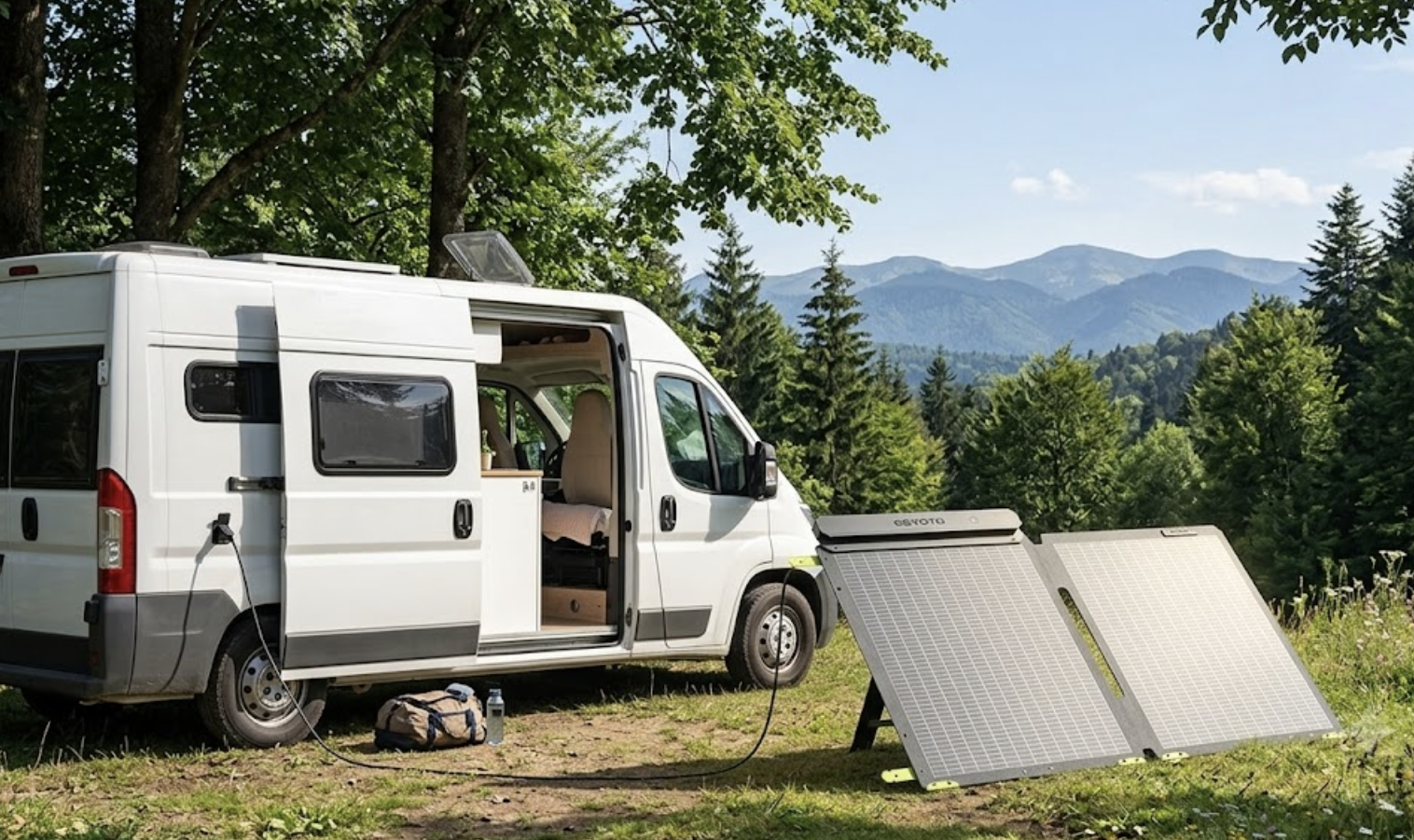
Fixed rooftop arrays and portable modules offer distinct advantages depending on individual camp layouts and climate conditions. Rigid panels permanently mounted to an RV roof provide convenient passive charging while driving along open highways. Nevertheless, this static configuration suffers from a fundamental geographic limitation known as the micro-climate parking paradox. To capture solar energy, operators must park their entire vehicle directly under intense midday heat waves. Conversely, deploying a mobile portable system allows travelers to park their vehicle inside cool forest shade while positioning the panel under open sunlight. Furthermore, fixed horizontal panels lose substantial operational efficiency when the sun hangs low on the horizon during winter travel seasons. Portable units easily resolve this common issue through adjustable structural kickstands that track seasonal solar angles precisely. This adjustability can meaningfully improve daily harvest versus a flat, fixed rooftop panel, though the actual gain depends on season, latitude, and how consistently you re-angle it through the day. Weight distribution also strongly favors modular portable configurations. Shifting to mobile hardware removes heavy top-heavy items from the vehicle chassis, improving fuel economy and vehicle stability. For these precise reasons, GEYOTO (GEYOTO Technology Limited) focuses on manufacturing high-performance portable modules that maximize deployment flexibility for diverse overlanding setups.
Q3: Why is Permanently Mounting Foldable Fabric Solar Modules on an RV Roof Scientifically Discouraged?
Some owners attempt to permanently bolt foldable fabric panels onto their vehicle roofs to combine the benefits of both systems. However, material sciences reveal that this practice causes rapid, irreversible structural degradation to the hardware. Folding solar modules utilize outdoor oxford fabrics and polymer seams designed for temporary deployment rather than continuous highway exposure. High-velocity wind shear creates intense, repetitive mechanical stress that tears fabric stitching apart over time. In addition, flat rooftop placement traps extreme ambient heat directly beneath the flexible photovoltaic cells. This total lack of airflow accelerates thermal degradation, causing permanent micro-cracks across the delicate silicon wafers. Rainwater also tends to pool inside the fabric folds during severe storms, leading to eventual moisture intrusion. This trapped moisture eventually corrodes internal copper busbars and causes terminal electrical short circuits. Ultimately, permanent roof mounting voids manufacturing warranties and destroys premium equipment. These specialized units perform best when operators deploy them on the ground and store them safely inside the vehicle during transit.
Q4: How Does Pairing the Panel with Advanced Energy Storage Hubs Achieve True Off-Grid Autonomy?
A portable panel operates strictly as a raw energy harvester rather than a stable storage container. Intermittent sunlight creates erratic voltage spikes that can easily damage sensitive electronic devices like laptops or essential medical equipment. Therefore, achieving true off-grid independence requires connecting the solar panel directly to an advanced energy storage hub. This crucial integration transforms unpredictable solar energy into a highly regulated, stable microgrid for various camper environments. These mobile hubs prove equally effective when managing a temporary backup household scenario during unexpected residential utility grid failures. GEYOTO Technology Limited designs its entire product ecosystem around this unified system logic. For instance, pairing a 100W portable panel with the N1000 generator gives you a workable daily charging routine — though whether it's truly “self-sustaining” still depends on your actual daily draw. The built-in maximum power point tracking controllers optimize input voltage dynamically to maximize charging speeds under cloud cover. Premium monocrystalline cells ensure an exceptional twenty-six percent conversion efficiency rate, feeding clean energy steadily into the internal battery cells. This seamless technical harmony protects sensitive onboard electronics while guaranteeing a continuous power supply through dark nights.
Conclusion: Resolving the Ultimate Off-Grid Upgrade Equation with GEYOTO Architecture
Evaluating these technical variables confirms that a high-quality portable setup represents the ultimate off-grid upgrade for modern nomads. However, operational success depends entirely on treating the panel as an active component of a wider, well-balanced energy ecosystem. By understanding load calculations, avoiding roof-mounting mistakes, and verifying connector and voltage compatibility before pairing hardware, travelers unlock genuine electrical freedom. GEYOTO actively supports this high standard of mobile autonomy through superior structural engineering and exceptional post-purchase support systems. The firm ships every order free of charge from its own US warehouse, ensuring rapid product delivery for domestic customers. Every unit ships with a standard 1-year warranty, extendable to 3 years for registered members. Curious if the S100 fits your rig's power draw? Run the numbers and shop current models at https://www.geyoto.com/.
GEYOTO Technology Limited
GEYOTO Technology Limited
+ +1 213 292 9187
email us here
Visit us on social media:
Instagram
Facebook
YouTube
TikTok
Legal Disclaimer:
EIN Presswire provides this news content "as is" without warranty of any kind. We do not accept any responsibility or liability for the accuracy, content, images, videos, licenses, completeness, legality, or reliability of the information contained in this article. If you have any complaints or copyright issues related to this article, kindly contact the author above.
