

Life Sciences BPO Market to reach USD 1,198.5 Billion by 2035 at 9.45% CAGR
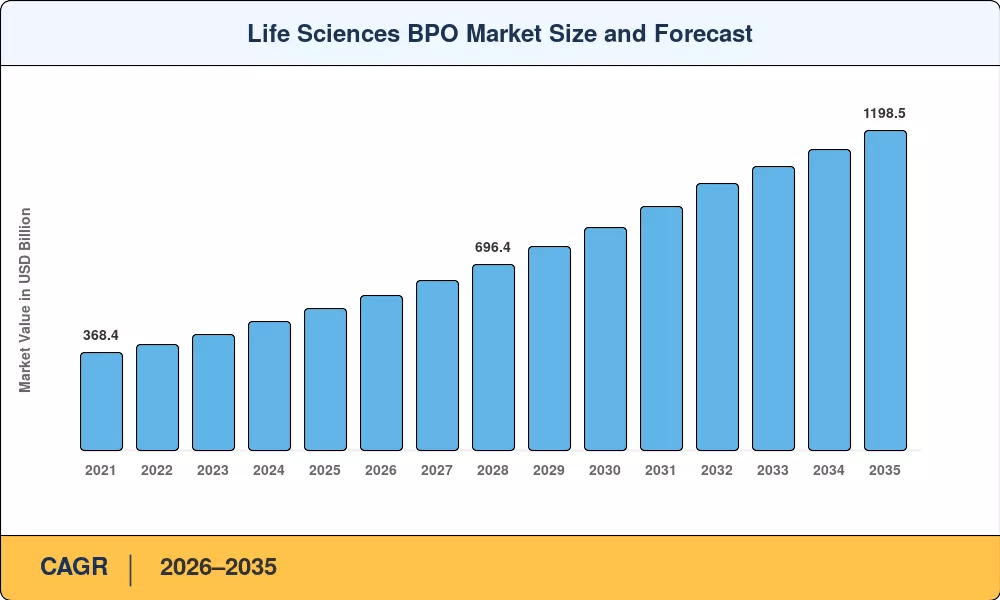
Life Sciences BPO Market Size
Life Sciences BPO Market to Surge from USD 581.4 Bn in 2026 to $ 1,198.5 Bn by 2035-By Inflation Reduction Act Margin Pressure, FDA Decentralized Trial Guidance
NY, CA, UNITED STATES, June 19, 2026 /EINPresswire.com/ -- As per Market Research Future, the global Life Sciences BPO Market size to reach USD 1,198.5 Billion by 2035 from USD 581.4 Billion in 2026, at a CAGR of 9.45% during the forecast period 2026--2035. The market base was estimated at USD 531.2 Billion in 2025.The 9.45% CAGR---anchored by structural R&D and commercial outsourcing demand rather than discretionary healthcare spending---is driven by three converging forces: the Inflation Reduction Act's drug-pricing provisions that compel pharmaceutical companies to protect margins through outsourced operations, sustained FDA decentralized trial guidance that has created fresh demand for clinical data management outsourcing and remote monitoring infrastructure, and AI-automated regulatory and safety functions that have converted bioscience back-office operations from labor-intensive cost centers into intelligent automation platforms.
National governments and multilateral health organizations are amplifying this momentum. The worldwide biologics pipeline has expanded by 64% since 2019, with more than 8,400 active biologic candidates in clinical development as of early 2025. The U.S. Inflation Reduction Act's Medicare drug-price negotiation provisions cover 60 drugs by 2029, compressing branded-drug margins and forcing pharmaceutical companies to pursue aggressive cost optimization through pharmaceutical outsourcing services.
Request A Free Sample:
https://www.marketresearchfuture.com/sample_request/10167
Key Market Trends & Growth Drivers
Inflation Reduction Act Margin Pressure and Drug-Pricing Legislation
The US Inflation Reduction Act's Medicare drug-price negotiation provisions cover 60 drugs by 2029, compressing branded-drug margins and forcing pharmaceutical companies to pursue aggressive cost optimization through pharmaceutical outsourcing services. European parallel-import rules and Germany's AMNOG reference-pricing updates compound the pressure.
A recent report estimates that top-20 pharma companies will redirect 12--15% of internal operational budgets toward outsourced clinical data management outsourcing, regulatory affairs services, and commercial-support functions by 2028.
Each percentage point of margin compression translates into measurable procurement volume for bioscience back-office operations, and the drug development support services embedded in routine pharma operations make this driver structurally durable through 2035.
FDA Decentralized Trial Guidance and Hybrid Clinical Models
Legacy paper-based regulatory submissions and manual pharmacovigilance workflows are giving way to AI-powered platforms that automate adverse-event detection, regulatory affairs services, and real-world evidence generation. The FDA's May 2023 final guidance on decentralized clinical trials formalized remote consent, home-nursing visits, and direct-to-patient drug shipment.
Sponsors adopting hybrid trial designs report 25--35% faster enrollment timelines and 20% lower per-patient costs. CROs that built digital trial platforms---IQVIA's Decentralized Trials suite and Medidata's Rave Home---captured disproportionate share in 2024, accelerating demand for bioscience back-office operations, including e-consent management and wearable-data integration.
AI-Automated Regulatory & Safety Functions and Biologics Pipeline Expansion
Natural-language-processing technologies now automate 40--50% of clinical study report authoring, and machine-learning algorithms identify probable adverse events in real time across pharmacovigilance databases. The FDA Sentinel System handles approximately 900 million patient records yearly, and outsourced safety vendors are linking their platforms with Sentinel to offer quicker signal detection to sponsors.
Accenture estimates that life sciences companies deploying intelligent automation across outsourced functions can reduce cycle times by 30--40%, unlocking roughly USD 18 billion in annual efficiency gains industry-wide. The worldwide biologics pipeline has expanded by 64% since 2019, with more than 8,400 active biologic candidates in clinical development as of early 2025.
Ask for Customization:
https://www.marketresearchfuture.com/ask_for_customize/10167
Market Segment Insights
BY SERVICE TYPE
CRO Services: Dominant segment with ~46.9% revenue share in 2024. Reflecting sustained demand for externalized clinical development and clinical data management outsourcing capabilities. Large-scale CROs like IQVIA, Covance (LabCorp Drug Development), and PPD (Thermo Fisher) manage end-to-end clinical programs spanning Phase I--IV across all therapeutic areas. The breadth of clinical data management outsourcing demand---from protocol design through database lock---ensures CROs remain the backbone of externalized development.
CDMO/CMO Services: Fastest-growing service segment at 12.2% CAGR (2026--2035). Biologics manufacturing and cell-gene therapy capacity constraints push drug development support services toward specialized partners. Over 40% of new drug approvals in 2024 were biologics, and fewer than 30% of biotech sponsors own manufacturing capacity. Samsung Biologics, Lonza, and WuXi Biologics dominate large-scale mammalian cell culture, while niche CDMOs focus on antibody-drug conjugates, mRNA, and viral vectors for cell-gene therapies.
BY END USER
Pharmaceutical Companies: Dominant segment with ~61.3% revenue share in 2024. Leveraging full-service partnerships to manage complex R&D pipelines. Top-20 pharma firms outsource an estimated 45--55% of their clinical development activities and increasingly rely on pharmaceutical outsourcing services for commercial launch support, medical-information call centers, and health-economics outcomes research.
Biotechnology Companies: Fastest-growing end-user segment at 9.1% CAGR (2026--2035). Venture-funded clinical programs requiring scalable drug development support services. Biotechnology companies, while individually smaller, are collectively the fastest-growing end-user segment as venture-funded startups outsource nearly all bioscience back-office operations from company inception.
BY OUTSOURCING MODEL
Full-Service Outsourcing (FSO): Dominant model with ~49.7% share in 2024. End-to-end program management anchors this segment. FSO contracts transfer end-to-end accountability to the vendor, including timelines and deliverables. FSO suits smaller sponsors lacking internal infrastructure.
Functional Service Provider (FSP): Fastest-growing model at 10.6% CAGR (2026--2035). Sponsor control over critical functions drives demand. The FSP model grew 15% year-over-year in 2024, as mid-size pharma companies sought tighter oversight of clinical data management outsourcing and biostatistics functions without bearing full headcount costs. FSP arrangements embed outsourced staff within the sponsor's operating structure under sponsor oversight.
Read Detailed Insights:
https://www.marketresearchfuture.com/reports/life-sciences-bpo-market-10167
Regional Outlook
North America -- Dominant Market (~44.8% Share, 2024)
The United States generates approximately 82.4% of North American Life Sciences BPO Market revenue, driven by the FDA's expanding submission requirements and the concentration of 14 of the world's 20 largest pharmaceutical companies---a single policy ecosystem that converted an in-house-dominated market into one with a structural outsourcing tail.
The US dominates through a combination of robust regulatory complexity, dense clinical-trial infrastructure, and rapid adoption of decentralized trial platforms. CMS bundled payment models incentivize quality-driven programs, while FDA breakthrough designations accelerate novel drug approvals.
Europe -- Second Largest (~26.3% Share, 2024)
Europe's Life Sciences BPO Market reflects divergent national strategies---Germany leads regionally with its strong CDMO base in Bavaria and Hessen and EMA relocation benefits, contributing ~23.5% of regional share, while the UK historically used selective outsourcing targeting before broadening coverage through MHRA agile regulation post-Brexit at 8.6% CAGR.
France contributes USD 18.4 Billion through a Sanofi-anchored outsourcing ecosystem. Italy is growing at 7.9% CAGR on API manufacturing cluster in Lombardy. Spain contributes USD 9.1 Billion on growing clinical trial hub for oncology.
Asia-Pacific -- Fastest-Growing Region (9.2% CAGR, 2026--2035)
Asia-Pacific is the engine of the Life Sciences BPO Market. China holds the largest regional share with ~28.6% of regional revenue, driven by domestic biotech boom and CRO scale---WuXi AppTec, Pharmaron, and Tigermed processed over 3,200 IND-enabling studies in 2024 alone. India is growing at 12.4% CAGR on the back of PLI scheme and CDMO greenfield investments in Gujarat, Hyderabad, and Chennai.
Japan contributes USD 24.7 Billion through aging population and PMDA reform at steady pace. South Korea is growing at 10.8% CAGR on Samsung Biologics and biosimilar pipeline expansion.
Middle East & Africa -- Emerging Opportunity (7.8% CAGR, 2026--2035)
The Middle East & Africa carries the widest infrastructure gap and therefore the steepest opportunity. Saudi Arabia leads the region with Vision 2030 healthcare investment, contributing ~34.8% of regional share---earmarking USD 65 billion for healthcare infrastructure, including pharmaceutical manufacturing parks and clinical data management outsourcing centers in Riyadh and Jeddah.
The UAE is growing at 9.4% CAGR on Dubai Healthcare City and free-zone incentives. South Africa contributes USD 3.1 Billion on SAHPRA reforms and HIV/TB trial expertise.
South America -- Growing Presence (USD 22.8 Billion, 2025)
Brazil anchors South America's Life Sciences BPO Market at ~62.4% of regional revenue, with ANVISA's alignment with ICH guidelines and a patient population exceeding 210 million that makes it attractive for large-scale clinical trials, providing a stable demand floor that smooths regional forecasts. Argentina is growing at 8.9% CAGR on clinical trial cost advantage---sponsors achieve 35--40% savings on per-patient trial costs relative to the US.
Competitive Landscape and Recent Developments
The Life Sciences BPO Market exhibits low concentration, with the top five players commanding an estimated 28--33% combined revenue share and a Herfindahl-Hirschman Index below 600. Consolidation accelerated through 2023--2025---most dramatically with Novo Holdings' USD 16.5 Billion acquisition of Catalent---but the sheer breadth of outsourced functions, from CRO trial management to regulatory affairs services and supply-chain logistics, sustains a fragmented competitive environment where specialized providers coexist with integrated full-service platforms.
The competitive landscape is stratified between integrated data-and-services leaders serving global pharma markets, vertically integrated pharma services providers capturing multi-channel tenders, and premium biologics capacity specialists consolidating the CDMO/CMO segment.
KEY COMPANIES AND RECENT MILESTONES
IQVIA (2024--2025): Maintains leadership with Connected Intelligence platform and real-world evidence capabilities, commanding ~7--10% of global Life Sciences BPO Market revenue. Integrated data-and-services leader with global pharma market presence. Premium positioning in clinical data management outsourcing and analytics offsets price compression in commoditized segments.
Thermo Fisher Scientific (PPD) (2024--2025): CRO, laboratory services, and clinical logistics anchor a vertically integrated pharma services franchise, holding ~5--8% of global revenue. The company benefits from the structural clinical trial tail created by expanded decentralized trial adoption.
Lonza (2024--2025): CDMO biologics and cell-gene therapy manufacturing reinforce the premium biologics capacity provider positioning, holding ~4--6% of global revenue.
Future Outlook: 2026--2035
By 2030, AI-native outsourcing operations and platform-based ecosystems will become the operating system of life sciences BPO. By 2030, MRFR expects over 60% of pharmacovigilance case processing and 45% of regulatory submission assembly to be handled by AI-augmented workflows within outsourced environments. The Life Sciences BPO Market will bifurcate between providers that deploy proprietary AI platforms and those relying on manual labor models.
Generative AI is already writing first drafts of clinical study reports, and large-language-model-based regulatory intelligence tools are scanning 150+ global health authority databases simultaneously to flag relevant guideline changes for regulatory affairs services teams. Machine-learning models trained on clinical trial datasets can predict enrollment bottlenecks and site-performance risks with 85% accuracy, enabling proactive resource reallocation by CROs.
More Related Research Insights:
https://www.marketresearchfuture.com/reports/contract-research-organization-market-3322
https://www.marketresearchfuture.com/reports/healthcare-bpo-market-1335
https://www.marketresearchfuture.com/reports/pharmaceutical-contract-manufacturing-market-1532
https://www.marketresearchfuture.com/reports/clinical-trials-market-7787
https://www.marketresearchfuture.com/reports/pharmacovigilance-market-8451
https://www.marketresearchfuture.com/reports/drug-discovery-services-market-5870
https://www.marketresearchfuture.com/reports/medical-writing-market-8370
https://www.marketresearchfuture.com/reports/healthcare-regulatory-affairs-outsourcing-market-7804
https://www.marketresearchfuture.com/reports/biopharmaceuticals-market-8439
https://www.marketresearchfuture.com/reports/clinical-data-management-system-market-32286
Larry Wilson
WantStats Research And Media Pvt. Ltd.
+1 855-661-4441
email us here
Visit us on social media:
LinkedIn
Facebook
YouTube
X
Legal Disclaimer:
EIN Presswire provides this news content "as is" without warranty of any kind. We do not accept any responsibility or liability for the accuracy, content, images, videos, licenses, completeness, legality, or reliability of the information contained in this article. If you have any complaints or copyright issues related to this article, kindly contact the author above.
